
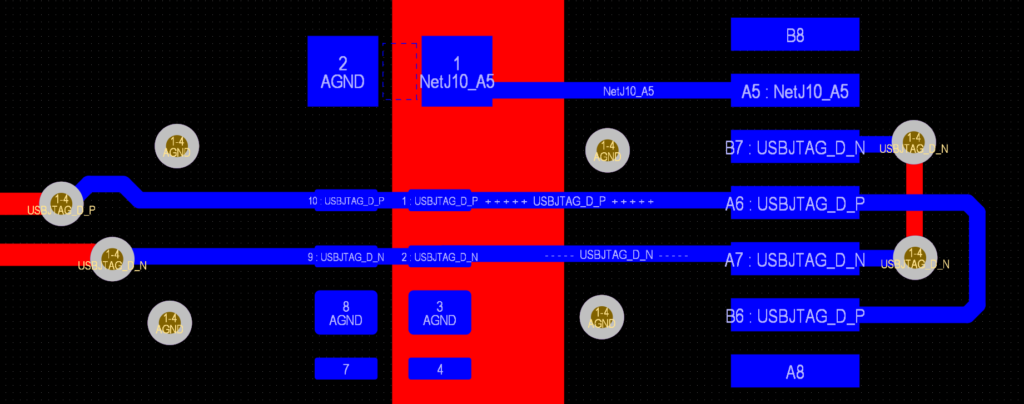
In the world of high-speed PCB design, “noise” is the enemy. As we push data rates higher, the traditional single-ended signal—a single trace referenced to ground—starts to fail us. It becomes a victim of EMI, ground loops, and crosstalk.
Enter the Differential Pair.
Today, we are breaking down the fundamentals of differential signaling, why it is the backbone of protocols like USB, PCIe, and Ethernet, and the parameters you must control to ensure signal integrity.
What Exactly is a Differential Pair
At its simplest, a differential pair consists of two parallel traces routed side-by-side. Instead of carrying one signal, they carry two:
The Positive Signal (D+ / P): Carries the original signal.
The Negative Signal (D- / N): Carries an equal and opposite version of the signal.
The Three Pillars of Physical Layout
To make a differential pair work, we must strictly control the geometry. Any variation in these three parameters can lead to impedance mismatches and signal reflections:
Trace Width (W): Directly affects the characteristic impedance of each trace.
Spacing (S): This influences the “coupling” between the two traces. The closer they are, the more they talk to each other.
Height (H): The distance from the traces to the reference Ground (GND) plane. This impacts both crosstalk and overall impedance.
Expert Tip: While we talk about these as individual traces, they function as a single unit. Consistency is the name of the game.
The Secret Sauce: Differential Receiver Measurement
Why go through the trouble of routing two traces? It all comes down to the math at the receiver. A differential receiver doesn’t care about the voltage relative to ground; it only cares about the difference between the two lines.
$$V_R = (V_P – V_{GND}) – (V_N – V_{GND})$$
If we simplify this: $$V_R = V_P – V_N$$
Common-Mode Noise Rejection
Ground Potential Cancellation
In complex systems with multiple PCBs, “Ground” isn’t always $0V$. If PCB1 is at $0V$ and PCB2 is at $-0.5V$, a single-ended signal would be corrupted. But with a differential pair, that $-0.5V$ offset exists on both lines. When the receiver subtracts them, the offset cancels out perfectly.
Common-Mode Noise Rejection
Imagine a nearby power converter emits a burst of EMI. Because the traces are routed so closely together, the noise ($V_{Noise}$) hits both traces equally.
$$V_R = (Signal_P + V_{Noise}) – (Signal_N + V_{Noise})$$
$$V_R = Signal_P – Signal_N$$
The noise effectively “subtracts itself” out of existence. This is why differential pairs are incredibly “quiet” and immune to external interference.
Impedance: The Field Solver Factor
In single-ended traces, we focus on Characteristic Impedance ($Z_0$). In differential pairs, we must manage Differential Impedance ($Z_{diff}$).
Because the two traces are electromagnetically coupled, their fields interact. There is no simple formula for this; to get it right for a professional board (like a 100Ω USB pair), you need a Field Solver. Tools like Altium Designer use complex algorithms to account for width ($W$), spacing ($S$), and height ($H$) simultaneously.
Key Takeaways for Your Next Layout
- Net Naming: Always label your nets clearly with _P and _N suffixes.
- Length Matching: To ensure the signals arrive at the same time and cancel noise effectively, the traces must be the same physical length. Use serpentine tuning if necessary.
- Consistency: Keep your width and spacing identical throughout the entire route.
Coming Up in Phase 2: We will dive into S-Parameters, Skew, and Advanced Routing Techniques to handle GHz speeds without breaking a sweat.
Found this helpful? Stay tuned to PCB Yantra Labs for more deep dives into the world of PCB design.